
How to Develop Your Consciousness
States, Stages and the Realms of Reality

Introduction
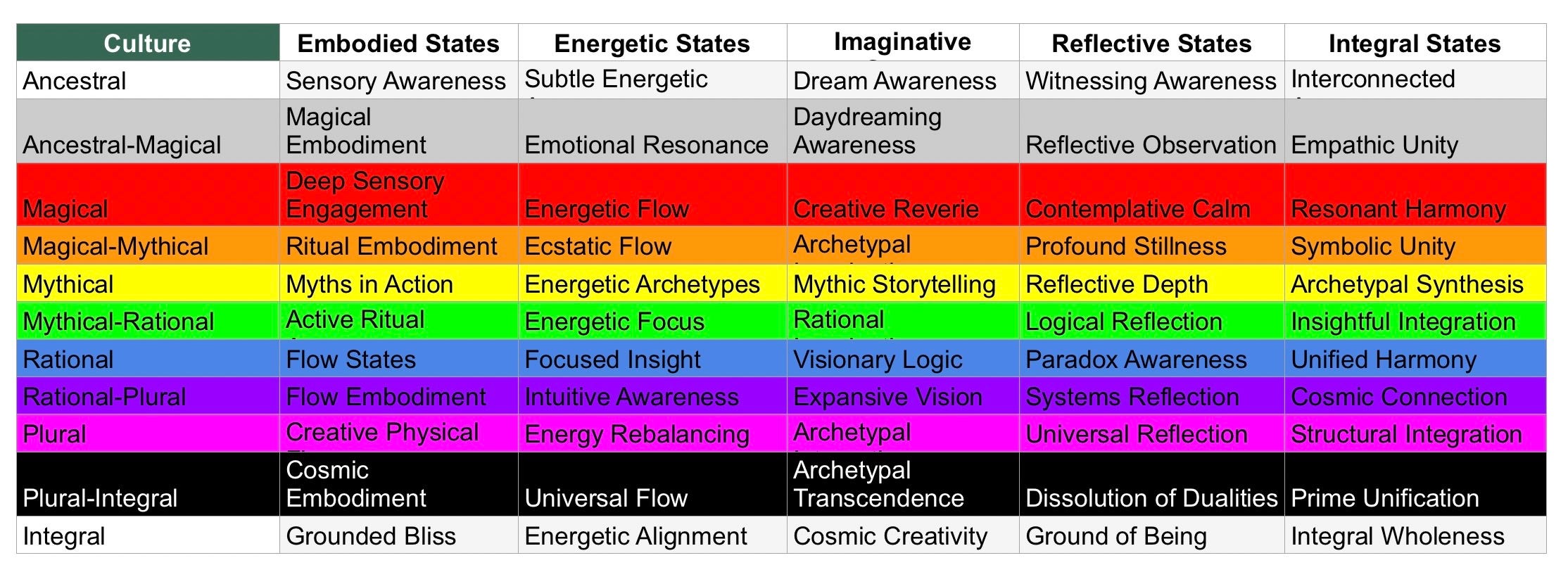
In the following article I’ll be delivering one final framework: The Realms of Reality, and I’ll use it to answer a question that so far has not been answered by the other frameworks, internal or external to my model.
But for those to make sense we have to talk about states and stages, and some metaphors I use to clearly navigate and articulate the navigation between them. All terms are contextualised here by the table that displays the Realms of Reality.
Glossary
Levels
The levels are the horizontal rows in the table. The levels are represented by a corresponding number, and often by a corresponding culture. The first level is 0:Ancestral. The last level on the tables I’ve presented are 10:Integral. This doesn’t nullify the existence of later levels like 11:Integral-Ancestral but more on that later.
Pillars
The Pillars are the vertical columns in the table. The pillars are represented by a name. For example in the Realms of Reality framework there are 5 names for pillars: Embodied, Energetic, Imaginal, Reflective and Integral.
States
States are the main contents of the frameworks, represented by the cells in the table. They sit underneath the pillar names and on the right of the names of the levels. They are the parts of the frameworks we experience directly, even if only temporarily. For example I may achieve a Flow State or Dream State, but only temporarily.
Paths
Paths represent the movement across the states of a particular level. For example at level 0:Ancestral I may move between Sensory Awareness, Subtle Energetic Awareness, Dream Awareness, Witness Awareness and Interconnected Awareness. Beginning on the top left each step right relies on the state before it, which is still available to you as you follow the path.
Streams
Similarly, streams represent the movement across the states of a particular pillar. For example in the pillar that represents the embodied realm I can move between Sensory Awareness, Magical Embodiment, Deep Sensory Engagement, Ritual Embodiment and so on. Beginning at the top as you move down each state relies on the state above it, and you keep access to upstream states as you move downstream.
Structures
Structures are the territories that contain the states you have access to. They are areas that span several levels and pillars. We often have access to more pillars than levels.
Stages
A stage signifies the level that you most often operate in. It’s the centre of gravity for your given structure. To say I am at stage 7 doesn’t mean I don’t have access to states outside of level 7, it just means I can more readily access those states at will.
Stages as Seasons & Weather as States
Consciousness, as I’m sure you’re aware, is not a static experience. We grow, we change, as do others and the world around us. We’re used to longer term developments in the way that each season develops one stage after the other. At the same time we’re used to shorter term developments in the way the weather changes around us and takes different states.
This is a good way to think of states and stages here. States are shorter term, temporary, can come in any order, and more than one can occur at the same time. Stages are longer term, sometimes seemingly permanent, and generally are linear, though not always. They also generally occur one at a time, although later stages tend to include and be dependent on earlier stages. Just because stages seem more concrete doesn’t mean that they are solid. Those liminal moments between seasons are stark reminders of this.
A key insight is that stages are made up of states, in the way seasons tend to be associated with particular types of weather. This means over each stage in the year we might expect to find more of certain types of states and less of others, despite the non-linear day to day state changes.
We could say seasonal change is one of the pillars of life on earth, starting with spring at the top, followed by summer, then autumn, with winter at the base. In a similar way we could view the course that shifting weather patterns take across the year as paths painted across the blocks of the pillar. These metaphors of pillars and paths come in handy especially when it comes to developing our own consciousnesses. Once we’re done here you can go back and use the same principles to understand the Model of Human Development and the Matrix of Existence.
It must also be noted that as time has moved forward wider structures and later stages of consciousness have become more and more prevalent in the human species.
The Realms of Reality
Existence emanates. That’s the central claim of Emanism, and it’s where the Realms of Reality begin. The starting point is simple: conscious beings don’t experience existence as a single undifferentiated thing. We experience it through dimensions. Through the body. Through feeling. Through image and story. Through reflection. Through moments of wholeness that dissolve the boundaries between self and world.
These dimensions are what I call the Realms of Reality. There are five: Embodied, Energetic, Imaginal, Reflective, and Integral. They aren’t physical places. They aren’t stages to pass through and leave behind. They are the permanent pillars of conscious experience, present at every level from 0:Ancestral to 10:Integral, taking different forms as consciousness complexifies.
Each realm corresponds to a dimension of existence that NET identifies in its unfolding. The body is matter. The energetic is force. The imaginal is the symbolic capacity that Wynter names as uniquely human. The reflective is self-awareness turning back on itself. The integral is emanance, existence known as one circuit. The path at every level moves through them in that order. Not because the later realms are better, but because each one depends on the one before it. You can’t reflect on what you haven’t first imagined. You can’t imagine what you haven’t first felt. You can’t feel what you haven’t first inhabited as body.
Symbolically the five realms correspond to the classical elements: Earth, Water, Fire, Air, and Spirit. In practical terms they map onto the physical, the emotional, the mental, the self-aware, and the spiritual dimensions of existence. These aren’t hierarchical. Spirit doesn’t outrank Earth. The integral doesn’t supersede the embodied. Each realm is a permanent dimension of experience, not a rung on a ladder.
The Realms Explained
The Embodied realm is where existence begins. It corresponds to Earth, to the physical body, to the most immediate fact of being alive. At level 0 this is Sensory Awareness, pure undifferentiated presence. As consciousness complexifies the embodied states deepen, from Magical Embodiment through Ritual Embodiment, Flow States, and eventually Grounded Ecstasy at level 10. The body doesn’t get left behind as we develop. It gets more fully inhabited.
The Energetic realm corresponds to Water, to force, to the felt sense of aliveness that moves beneath sensation. In NET, forces emerge from relationships. The energetic realm is where we experience that directly, as emotion, as vitality, as the quality of attention we bring to any moment. Breathwork, movement, and somatic practice cultivate this realm because they work at the level of force before it becomes thought.
The Imaginal realm corresponds to Fire, to the mind’s capacity for symbol, image, and story. This is Wynter’s homo narrans in practice. We are the species that doesn’t just perceive the world but narrates it, and those narratives shape our biology as much as our genes do. The imaginal is where archetypes live, where dreams speak, where culture is first generated before it solidifies into structure. Okediji’s sensiotics begins here, before language, in the felt meaning of image and sound.
The Reflective realm corresponds to Air, to self-awareness, to the ability to watch the mind think. MERC tracks how this capacity develops from the most basic intra-subjective awareness at level 1 through to the dissolution of dualities at level 9. What changes across levels isn’t the capacity to reflect but the depth and scope of what reflection can hold. At the Rational stage Paradox Awareness sits here for a reason: it’s where rationality encounters its own limits and either collapses or opens.
The Integral realm corresponds to Spirit, understood as the coherence of the other four. It’s the experience of wholeness that arises when the embodied, energetic, imaginal and reflective are moving together rather than in isolation. At level 0 this is Interconnected Awareness, the animist sense that everything is alive and related. At level 10 it is Integral Wholeness, the same knowing arrived at again after the full complexity of the circuit has been traversed.
Realms, States and Stages: Understanding the Progression
The realms are the pillars. The rows are the levels. States are what live in the cells where they meet. This means consciousness develops in two directions at once: horizontally across the realms within a given level, and vertically through the levels within a given realm.
Moving horizontally across a level is following a path. At any given stage you move from the Embodied state through to the Integral state, each step depending on the one before it. You don’t access Witnessing Awareness at level 0 without first moving through Sensory Awareness, Subtle Energetic Awareness and Dream Awareness. The path is the scaffold.
Moving vertically within a pillar is following a stream. The Embodied stream runs from Sensory Awareness at level 0 to Grounded Ecstasy at level 10. Each state in that stream depends on the states above it. You don’t arrive at Flow States without having moved through Magical Embodiment, Deep Sensory Engagement, Ritual Embodiment and Myths in Action first. The stream is the foundation.
This is why stage shift requires both exposure and scaffolding. Exposure moves you along the path into unfamiliar states within your current level. Scaffolding ensures you’re moving through the sequence rather than leaping across it. And foundation ensures the streams beneath your current stage are genuinely integrated rather than merely visited.
Paths of Consciousness: Expansion and Integration
Consciousness development is not just about expanding into new states but about integrating them. Both processes are necessary and they work differently.
Expansion is movement into states outside your current stage. This can happen along a path, moving into a realm you haven’t yet accessed at your level. It can also happen along a stream, glimpsing states from levels above your current stage. Peak experiences, whether through practice, relationship, crisis or altered states, are typically expansion without integration. The state was real. The structure wasn’t ready to hold it.
Integration is what happens when an expanded state gets metabolised into the stage. The structure reorganises around it. This is slower, less dramatic, and entirely dependent on foundation. If the levels beneath your current stage aren’t settled, integration stalls. The structure grows but the stage doesn’t stabilise. You can access more states but you can’t reliably return to them. The centre of gravity doesn’t shift.
How to Shift Stages
Every developmental model maps the stages. None of them tell you how to move between them. That’s what this section does.
Stage shift requires three conditions working together: foundation, exposure, and scaffolding. Remove any one of them and you get a predictable failure mode. All three together and stage shift becomes not just possible but navigable.
Foundation
Foundation is the integration of levels below your current stage. Not exposure to them, not familiarity with them, but genuine integration. The streams beneath you need to be settled.
This matters because stages are built on each other additively. MERC makes this explicit: each relational perspective depends on the one before it. A Rational perspective depends on Systemic, which depends on Agentic, which depends on Objective, which depends on Intra-subjective, which depends on Subjective. You don’t skip the foundations and build higher. You build on sand.
The failure mode here is a structure that grows without a stage stabilising. You can access states from higher levels, through practice, through peak experience, through crisis, but you can’t reliably return to them. The centre of gravity doesn’t shift because there’s nothing solid enough beneath it to anchor a new one. More structure, same stage.
Exposure
Exposure is deliberate contact with states outside your current stage. The Realms of Reality provide the map for this. At your current level, identify which states along the path you can access reliably and which you can’t. The states just beyond your reliable access are where exposure is most productive.
The failure mode here is peak experience without integration. The state was real. The insight was genuine. But without foundation and scaffolding the experience remains an outlier rather than becoming a new centre of gravity. This is why psychedelic experiences, spiritual emergencies, and moments of profound crisis can expand a person’s sense of what’s possible without shifting their stage. Exposure alone is necessary but not sufficient.
Scaffolding
Scaffolding is the sequence. The paths in the table aren’t arbitrary. They reflect the logical dependence of each state on the one before it. You don’t move from Sensory Awareness to Dream Awareness without moving through Subtle Energetic Awareness. You don’t access Visionary Logic without first developing Flow States and Focused Insight.
This means stage shift isn’t about seeking the most dramatic or elevated state available. It’s about moving methodically along the path at your current level, ensuring each state is accessible before moving to the next, and letting that accumulated access create the conditions for the stream to deepen and the stage to shift.
The same logic applies in reverse. When structure disintegrates under pressure, when crisis, loss, or overwhelm collapses access to states you previously held reliably, the scaffold shows you where the foundation is thin. Disintegration isn’t failure. It’s diagnostic. The level where the structure collapsed is the level that needed more integration before you built above it. The path back is the same path forward, just slower and with more attention paid to what was skipped the first time.
The Circuit
The three conditions form a circuit. Foundation provides the ground. Exposure provides the contact. Scaffolding provides the sequence. Together they turn stage shift from something that happens to you into something you can participate in consciously.
The Gleaning model names this process from the learning side: Determine, Attune, Cohere, Clarity, Insight, Embodiment, Expression, Agency, Resilience, Homeostasis, Heterostasis. That sequence is the scaffold made explicit. Each step prepares the ground for the next. Each one depends on the integration of the one before.
As time has moved forward wider structures and later stages of consciousness have become more prevalent in the human species. The collective foundation deepens with each generation. But stabilising a stage remains an individual task. The map is shared. The work is yours.
The Journey (Re)Begins
The Realms of Reality are not a destination. They are a map of the terrain consciousness moves through as it develops. Five permanent dimensions of experience, present at every level, taking different forms as the structure deepens and the stage stabilises.
The question this piece set out to answer was how to shift stages. The answer is foundation, exposure, and scaffolding working together. Know which streams beneath you need deeper integration. Use the paths to identify where your exposure is most productive. Follow the sequence rather than leaping across it.
The deeper takeaway runs across the entire Map, not just the Realms of Reality. Stages are state based. Expanding your structure is state based. Exploring new levels is state based. Every framework in this system, NET, Power, Gleaning, Dichotomous Dialectics, MERC, MOHD, is ultimately describing territories of states and the relationships between them. The Realms of Reality make that explicit and give you the tools to work with it directly.
The circuit runs from meta-existence through the entire Map to the Eman Nation. The Realms of Reality sit inside that circuit as the experiential dimension. They are how the whole system is actually lived rather than merely understood.